


Markus Knall, Editor-in-Chief at Ippen Media, Germany


February 25, 2026 Case no. 39
Feature Webinar
Local Journalism Day: Building a movement across German-speaking Europe
Building on an idea at Ippen Media in Munich, the Day of Regional Journalism was launched in 2025 and is now spreading across Germany, Austria and Switzerland. The webinar will show how the initiative invites publishers to promote their journalism to locals by using May 5 as a shared moment to engage directly with communities. Participation is deliberately open, ranging from in-person encounters and editorial initiatives to social media campaigns that show what reporting looks like in practice. Isabel Russ, Editor-in-Chief at Russ Media in Austria, will share how their newsrooms plan to spotlight local journalists and their work, giving the people behind local news time to be seen and appreciated.
Presented by: Markus Knall, Editor-in-Chief at Ippen Media, Germany
and Isabel Russ, Editor-in-Chief, Russmedia, Austria

Isabel Russ, Editor-in-Chief, Russmedia, Austria


Click the image to watch the webinar! (For first time visitors to the WAN-IFRA Knowledge Hub there will be an initial registration step.)
By Niklas Jonason
Summary
This webinar showed how a deliberately simple, open framework can turn local journalism into a shared industry movement. In the webinar, Markus Knall explained how the idea emerged at Ippen Media from a growing concern: even without full “news deserts,” many European communities are left with only one local newsroom, increasing democratic risk if fewer journalists scrutinise local power. His solution is intentionally lightweight — one shared date (May 5), one shared hashtag, and open participation — allowing newsrooms of any size to join without contracts, fees or central coordination. The 2025 pilot across Ippen’s network combined service journalism, open-house encounters, and strong social media participation, creating both external visibility and an unexpected internal effect: local journalists felt proud to be publicly visible, which in turn strengthened community engagement beyond the day itself. The initiative is positioned less as editorial output and more as “newsroom marketing,” designed to remind audiences — especially non-subscribers — that local journalism is real people doing tangible work close to them, a message Knall sees as increasingly important in an AI-driven information environment.
Building on that foundation, Isabel Russ shows how the concept translates into practical newsroom execution at Russmedia in Austria. Their approach centres on making trust visible through people, process and impact: introducing reporters via short vertical videos while out reporting, launching a dedicated page profiling journalists, publishing concrete examples where reporting led to real-life change, and actively inviting audiences to share why local journalism matters. The Q&A reinforces two strategic insights: first, the initiative works as an internal flywheel, boosting pride and outward-facing behaviour among journalists; second, its growth potential lies in reaching beyond existing subscribers to new audiences through social formats and creator collaborations. Together, the presentations position Local Journalism Day not as a campaign but as an emerging collaborative model — one that could evolve into an international moment for local media, aligning newsrooms around a shared narrative of relevance, trust and civic value.
Actionable ideas
Build a “shared moment” with minimal friction and maximum collective signal. Treat the date (as May 5 2026 in german speaking countries) as a coordinated editorial marketing sprint: align your newsroom around this date date, one hashtag, and a small set of high-visibility formats. Use the common brand assets and playbook approach Markus outlined (templates, logos, ready-made social formats, best-practice ideas) so execution is lightweight and repeatable. Then close the loop: report your activities back to the organisers so the movement can aggregate, showcase, and amplify participation — turning isolated actions into a demonstrable, industry-wide presence.
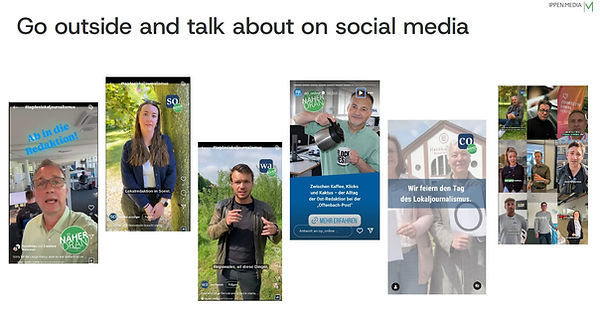
Make trust tangible: people, process, proof — with a clear growth goal beyond subscribers. Combine Markus’ “go outside” concept with Russmedia’s three-part structure: (a) make journalists visible (short vertical videos while reporting; staff profiles), (b) show impact (specific cases where journalism changed outcomes), and (c) create dialogue (collect and publish audience perspectives via social/newsletters). In the Q&A, Markus was explicit about prioritising non-subscribers and new relationships (followers, app downloads, contacts) rather than spending most effort on the already-converted. For younger audiences, both speakers converged on social-first execution and a pragmatic bridge: invite creators/influencers into the newsroom to document how local journalism works, in their voice and for their audiences.

About the Speakers
Markus Knall is Chief Editor and Director Content at Ippen Media, where he has led the development of one of Germany’s largest digital editorial networks. He has served as Chief Editor since 2011 and is based in Munich. Markus studied political science and history in Germany and Washington DC and holds an Executive MBA, combining editorial leadership with a strong strategic and business perspective on the future of local journalism.
Isabel Russ is Managing Director at Russmedia and Editor-in-Chief of Vorarlberger Nachrichten (VN) in western Austria. With experience across multiple industries and international markets including the USA, China and Singapore, she brings a global perspective to regional media. Since joining Russmedia in 2024, she has been driving the company’s digital transformation while reinforcing its local-first editorial mission.
Facts about Ippen Media
Chief Editor Markus Knall took the first initiative of “Local Journalism Day” in 2025 withing the Ippen Media Group. Ippen Media describes itself as Germany’s largest digital platform for news outlets, with 80 websites, 2,000 journalists, 29M readers per month, and 725k print circulation across its network. The 2025 Local Journalism Day pilot in the network produced 250+ articles across 50+ local news sites, generated 300,000+ pageviews, and included events plus extensive hashtag activity under #TagdesLokaljournalismus / #TdL.

Facts about Russmedia
Russmedia is a family-owned, internationally active media company rooted in local journalism in Bregenz, Vorarlberg (western Austria). With strong regional brands such as VOL.AT, the company combines a local-first editorial heritage with a clear digital transformation agenda.
Why is Local Journalism Day important?
Local Journalism Day is rooted in a shared concern highlighted by both Markus Knall and Isabel Russ: local journalism remains essential for democracy, trust and community cohesion — yet its value is often invisible to the wider public. Markus argues that even without full “news deserts,” more regions are left with only one local newsroom, increasing democratic risk when fewer journalists scrutinise local power. At the same time, in an AI-driven and socially fragmented information landscape, local media retain uniquely high trust because they are close, tangible and human. Isabel reinforces this by framing the day as a shift from what we publish to why it matters, making the people, impact and purpose of local journalism visible. The results from the first edition underline the potential of a coordinated approach: hundreds of stories, strong audience reach, widespread social engagement and broad industry participation demonstrated how a shared moment can amplify the civic value of local reporting. Together, these perspectives position Local Journalism Day as both a visibility campaign and a trust-building exercise — reminding audiences that local journalism is not abstract, but a living civic infrastructure rooted in proximity, accountability and real-world impact.


Examples from the Ippen Media Pilot
The 2025 pilot across Ippen Media’s network was built around concrete, highly local “proof points” of what journalism does in practice. At HNA, one featured story followed how the newsroom helped an elderly couple find a new apartment — a service-oriented case showing direct community impact. Another example was the “XXL-Flohmarkt”: a local newsroom near Munich helped to save a flea market, turning a threatened community institution into a shared local cause that readers could rally around. Alongside these kinds of service and community stories, many newsrooms complemented publishing with open houses, guided tours and panel discussions, inviting readers and subscribers into their buildings to see how reporting is produced and to discuss why local journalism matters. Across the network, the day produced 250+ articles on 50+ local news websites, generated 300,000+ pageviews, and triggered broad social participation through coordinated hashtag activity — demonstrating how many “small” local actions can add up to a visibly large collective moment.


Preparing for May 5th
For 2026, the initiative is shifting from a successful pilot to a broader industry movement. Markus Knall described how the project is now being co-developed with external partners, notably dpa (German Press Agency) and its innovation arm Drive, alongside WAN-IFRA and others. Crucially, the initiative has attracted backing from publisher associations across Germany, Austria and Switzerland, as well as support from Luxembourg, signalling a shift from a single-network experiment to a regional collaboration. A growing list of participating publishers — from major media houses to smaller local outlets — is already committing to May 5, reinforcing the idea that scale comes from openness rather than central control. To support this expansion, the organisers are providing an English-language website, an expanded playbook with best practices and templates, and additional webinars to help newsrooms prepare. The goal is to make participation frictionless while building a visible, cross-border coalition that demonstrates the collective strength of local journalism.


How to participate
Participation is intentionally simple and accessible to any newsroom, regardless of size or resources. As Markus Knall emphasised, the model is built around just two core rules: focus activity on May 5 and use a shared hashtag (#localjournalismday / #LJD, and local variants). Everything else is flexible — publishers can choose formats that match their capabilities, from small social activations to larger editorial or community initiatives. To make execution easy, organisers provide a central support package: an open website with guidance and assets, a downloadable playbook with best practices and templates (logos, social formats, ideas), and a series of preparatory webinars showcasing examples from participating newsrooms.
A key recommendation from Markus is to ensure at least one visible, collective action — for example sending journalists out into the community and sharing real-time reporting moments on social media — to reinforce the sense of a shared movement. Finally, participants are encouraged to share their plans and results with the organisers so activities can be aggregated and amplified, strengthening the collective visibility of the initiative.


What Russmedias VN is planning for May 5th
At Russmedias Vorarlberger Nachrichten (VN), Isabel Russ outlined a structured plan built around three clear goals: making journalists visible, demonstrating impact, and creating dialogue. A central element is strong use of short vertical videos, introducing reporters while they are out on assignments to make the people behind local journalism tangible and relatable. The newsroom will also launch a dedicated team page where audiences can explore profiles of journalists — who they are, what they cover, and what motivates their work — alongside behind-the-scenes glimpses into field reporting and editorial decision-making to “make the invisible visible.”
To underline journalism’s real-world value, VN plans to highlight concrete impact stories, including cases where reporting has led to meaningful change in people’s lives, such as accessibility improvements for a local child. In parallel, Russmedia wants to actively involve its audience by asking readers ahead of May 5 why local journalism matters to them, collecting responses via social media and newsletters and integrating those voices into coverage. Overall, Russ framed the day not as a campaign about output, but as a moment to explain purpose — shifting the focus from what local media publish to why their work matters for communities.
Questions and Answers from Martin and Isabel:
Question: When you ran the event at Ippen Media the first time in 2025, what was the reaction inside the newsroom?
Answer: Markus expected hesitation because resources are tight. Instead, the day created strong positive energy and a sense of movement. Journalists pushed to repeat it annually.
Question: Can the energy carry through beyond one day a year?
Answer: Markus said the strongest emotion was pride — local journalists often feel unseen. Being publicly visible as a team became a flywheel that generated more ideas and more community-facing work for weeks and months after the day.
Question: How should publishers balance subscriber-focused activity versus reaching the broader public?
Answer: Markus stressed not only “convincing the believers.” Subscriber-only events can be expensive; the bigger opportunity is engaging non-subscribers and building new relationships (contacts, followers, app downloads).
Question: Any concrete approaches for younger audiences — and the role of creators?
Answer: Markus pointed to social-first execution (Instagram/TikTok) and highlighted inviting creators into the newsroom as an easy way to explain journalistic work to audiences that already follow those creators. Isabel said Russmedia will integrate that idea into their concept.
Question: What about 2027 — could this become international?
Answer: Markus said the ambition is an international Local Journalism Day, but the priority is delivering a strong 2026 edition first.
The presentation, useful links and contact information
-
The slides of Martin Knall are here (in PDF):
-
Campaign site (in English):
-
Hashtags:
-
#localjournalismday and #LJD
-
(German: #TagdesLokaljournalismus #TdL)
-
-
Playbook with lots of examples of activities to be inspired by and plan for:
-
Contacts:
-
Web sites of Ippen Media and Russmedia:
-
You are welcome to contact the WAN-IFRA Innovate Local team, if you have questions or examples of similar cases.
-
Cecilia Campbell: c.campbell@wan-ifra.org
-
Niklas Jonason: n.jonason@wan-ifra.org
-
Addendum: Local News Day in the US on April 9
Just after having published this write up we realize that there is a similar initaitive in America with "Local News Day" on April 9. It is said that the idea came from Montana Free Press. The Local Media Association organise a free-to-all webinar next Thursday on March 5 at 8 pm CET. You can read more and register here: https://localmedia.org/event/webinar-local-news-day-how-to-join-the-movement/